St. Patrick's Day Resources for Life Skill Classrooms

If you are looking for language arts life skill worksheets to use this month as you teach about all things shamrocks and leprechauns related, check out these differentiated resources you'd need to teach this March. Check out all the St. Patrick's Day resources that have been tried and tested by special education teachers all over the country! 


St. Patrick's Day Resources Special Education Teachers Love
Here's some of the Breezy Special Ed St. Patrick's Day resources special education teachers to use in their classrooms:


St. Patrick's Day Journals

Winter Language Arts Resources for Special Education

Oh, hello there January! If you are looking for language arts life skill worksheets to use this month as you teach about all things snow and winter related, I have your back with all the differentiated resources you'd need to teach this winter. Check out all the winter resources that have been tried and tested by special education teachers all over the country! 


Here's some of the winter resources teacher like you love to use in their classrooms:

Christmas Shirts and Ornaments for Special Education Teachers

Are you a special education teacher who uses symbol support all day long with your students? In addition to the PECS, AAC devices, and symbol supported stories in your classroom, now you can add some symbols to your everyday teaching apparel as well! Also, who doesn't need an excuse to wear a comfy teacher tee to school ;)

Symbol Supported Christmas Tees for Special Education Teachers


This Merry Christmas sweatshirt comes with a scattered array of 9 Christmas symbols, such as holly, stocking, gingerbread, ornament, present, and more! It's the perfect shirt to wear the entire month of December and is available as a sweatshirt or t-shirt.

Creating a Calming Center in Your Classroom: A Guide for Special Education Teachers

Special education classrooms can greatly benefit from having a designated calming center where students can go to self-regulate when feeling overwhelmed or frustrated. This calm down space provides a safe and quiet environment for students to regain their composure. Here's how you can create an effective calming center that suits your classroom and your students' needs.


Setting Up Your Calming Center

Start by identifying a corner in your classroom that can be transformed into a calming center. Use items like bookshelves, dividers, tables, or desks to section off the area and create a cozy nook. If you have the space, consider adding comfortable seating options like a bean bag chair and a soothing bubble lamp. Additionally, incorporate smaller fidgets and visual aids to help students calm down and self regulate when feeling frustrated or overwhelmed

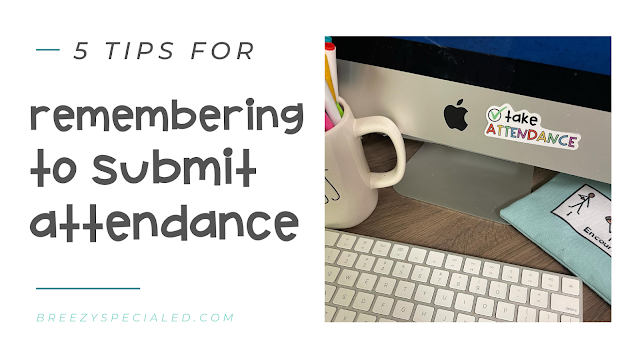
5 Ways to Help Teachers Remember to Take Attendance

Mornings are so busy, the last thing most teachers are thinking about is submitting attendance when there are students to say hello to, notes to read, lesson details to finalize, kids to help, etc! So, how can a teacher actually remember to take attendance? 

5 tips for remembering to submit attendance

Here are some tried and true ideas from seasoned teachers who shared their strategies on the BSE Facebook page. Check them out and let us know which one ends up working best for you!

A More Inclusive Halloween: Supports for Special Needs while Trick or Treating

Halloween is always so much fun for kids, because, well, candy...and special needs kids are no exception!

Here's a few ways to help individuals with special needs have an enjoyable trick-or-treating experience this year: including multiple AAC supports, a free social story, links to wheelchair cover costumes, teal pumpkin treats, and more! 


A More Inclusive Halloween: Supports for Special Needs while Trick or Treating

How to Say Trick or Treat for Non-Verbal Kids

Hopefully, most people are kind enough to pass out candy to every trick-or-treater who comes to their door with their bag open regardless of whether or not they say trick or treat, but it's also fun to be able to participate in saying "trick or treat".


Here are a few unique ways that non-verbal kids can say trick-or-treat!


Teaching Money Skills in Special Education

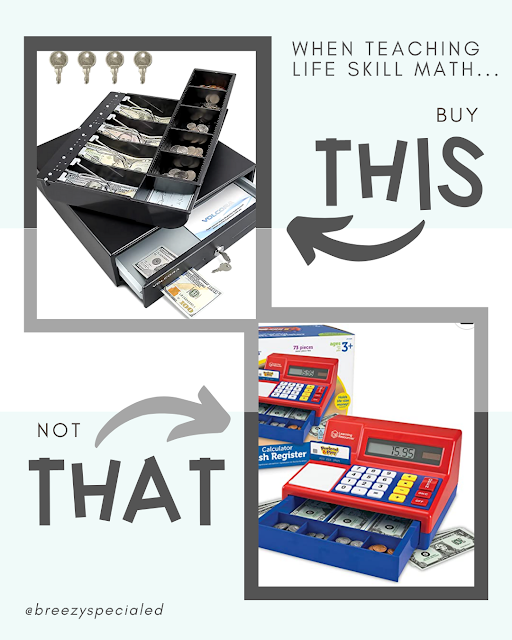
When teaching life skill math, make sure that what you are teaching is able to be transferred to life outside of the classroom. Seriously, you don't want to waste your time (and your students' time) on skills that won't be used in the real world! 

One of the easiest ways to do this when teaching money is to make sure the materials in your classroom are realistic.

Realistic Cash Register

I don't know why, but every "play" cash register I have found has spots for 3 bills. Why? I wish I knew! Pretty sure all normal cash registers have 4 (and maybe some bank specific ones have more). So when working with money in your classroom, buy a cash register drawer (amazon affiliate link) to use instead of a play cash register. It is just about the same price as the play version from Lakeshore learning!


Another great option is to see if anyone is donating an old cash register. Ask your local Buy Nothing group on Facebook.


Use Pretend Money...but Realistic Money

Obviously, the real thing is the best thing, but keeping cash in the classroom might not be the best option. Don't buy the play money that is all the same color. 

Students with special needs, they need something that is closer to the real thing like these ones (amazon affiliate link). Plus the color (like on our real dollars) makes it easier to identify which bill is which, which is especially helpful for students who aren't recognizing numbers.

5 NO PREP Resources for St. Patrick's Day and March Special Education

Are you feeling the drag of the school year by this point? Let me make it a little bit easier for you by showing you these resources that you can click, print, and use without any additional prep work or modification for your special education students.


Sound good? Here are 5 resources for March and St. Patrick's Day that are differentiated and ready to go!

Thankful Turkey Journal and Craft Activity for Special Education

The act of gratitude is important for everyone, and that includes our students with disabilities. It might be hard for our non-verbal students to express what they are thankful for, so I created these differentiated thankful turkeys to help!


Symbol Support

With this thankful turkey resource, students will be able to use the symbols to help them think about and choose the things they are thankful for. Then they can paste them on a turkey or on a journal to show what they are thankful for.

Creative Alternatives for IEP Transition Planning (COVID-19 friendly)

Being a special education teacher instructing remotely is far from easy. There are limited aspects of our jobs to see the benefits of teaching virtually over teaching in-person. For my friends who are special educators, you likely are facing double the challenge of having to wear two hats - one as a classroom teacher and the other as a special education case manager.


If there’s a silver lining in all of this, my Case Manager hat would be screaming “TRANSITION SERVICE PLANNING!”.  Formerly a process that was case-manager designed and facilitated around school-and community learning opportunities has been flipped upside down where students and their families are expected to take a more active role in-home and community-based activities.  Thanks to the shift to remote and blended learning, the top-down transition planning model is now a three-way shared responsibility (teacher, student, and parent/guardian).


Here are some creative alternatives to your traditional transition planning and implementation steps. These alternatives allow you to get the data and information you need to meet policy and planning purposes while providing students with opportunities to strengthen their self-determination skills and social skills. All the while making the parent/guardian experience stress and hassle-free by placing more responsibility on their child. For best results, confer with your IEP team members to solicit feedback and recruit support before attempting these alternatives.

Resources to Teach Women in History for Special Education

The month of March is National Women's History Month. What a great time to teach about some influential women in history. I've compiled some of my favorite resources to use with your special education class to get you started.


Women's History in Special Education - Resources to teach about Influential Women in History

Introduce the month by using this free national day journal activity that introduces the month of March as Women's History month. There are four different levels to help you reach all of your learners. 

Celebrating Each Day with National Day Journals

Add some more fun to your calendar routine with your special education class by talking about the national day. National Day discussion journals are the perfect activity to add into your morning meeting! Why might you want to include the national day during your morning calendar routine? There are a ton of reasons including:

  • Predictable routine - format stays the same while the topic changes
  • Knowledge - learn and discuss random topics
  • Relevant - people of all ages enjoy talking about the national day
  • Language Arts - listen, read, and write about the national day
  • Fun and Motivating - obviously :) 
  • Differentiated - Four levels of differentiated journals are included along with a symbol supported classroom poster to encourage classroom discussion and participation among students of ALL levels
  • NO PREP - use the BSE Symbol Supported National Day resource and simply print (or digitally assign) and GO!


Here's what the classroom poster and 4 levels look like and how you can use these in your special education classroom with multiple levels of learners:

Tips for Parent Communication for Distance Learning and Beyond

Now more than ever, it is essential that teachers are intentional about communicating with parents. Whether you are back to school in person or teaching remotely through a video platform such as Zoom, teachers and parents need to be on the same team, and here's some ways to help you get started with that.


I'm excited to introduce guest blogger, Heather from Full SPED Ahead today to help give us some more ideas on collaborating with parents.

Hey there, Heather from Full SPED Ahead here to take over the Breezy Special Ed blog for a day! I am currently a middle school functional life skills teacher. I’ve taught life skills for 7 years and it is my heart and soul! I love encouraging students to reach their full potential and gain overall independence as they work with me. Another thing I am passionate about is parent communication and collaboration. I hope these tips and tricks will help you gain trust and build relationships.

Time Saving Tips and Resources for Digital Special Education Classrooms

Are you back at school? Or at home teaching? Whatever your situation looks like this year, I know teaching virtually, in-person, or hybrid brings about new challenges, especially when teaching in special education. You are not alone, the Breezy Special Ed community is here to help!

I heard the analogy this weekend that teachers are currently building the plane as they are flying it. Sounds about right, right?! So be sure give yourself some grace and ask for help when you need it. This was definitely not anything we were prepared for in college, am I right?!

Don't try to reinvent the wheel if you have been thrown back into virtual teaching for this school year, you have more than enough on your plate already. 


Here's some things that may help you save some time and be more effective this year.

Back to School 2020 for Special Education

Does everyone feel like a first year teacher this year? There are so many changes and uncertainties about this school year and I know it can be overwhelming. I believe in control what we can control, and then making the best of whatever situation we are put in.

So, whether you are heading back to school in person, virtually, or a hybrid situation, here's some tips to help you get started!

TpT's Digital Activity Tool - turn PDFs into Interactive Digital Worksheets

I'm so excited about this new feature TpT is offering! Before if you wanted to assign a PDF to students digitally I would recommend Kami or SeeSaw...but this is even better.

With the TpT digital activity tool you can easily access and assign PDFs in Google Classroom for your students to complete by typing and drawing. Boom. Instant digital worksheet!


My husband and I have spent the last three days and countless hours adding text boxes to over 60 of my resources so that they will be even easier for you to use and assign to your students. All of the Breezy Special Ed Symbol Reading Comprehension and Easy Reading Comprehension PDFs are now fully set up for you to use with the TpT Digital Tool.

Here's how it works:

Life Skill Laundry Visuals for Special Education

For life skills education, it is important to include VISUALS and REPETITION while teaching important life skills tasks, such as laundry. With the right amount of support and practice, students can become more independent individuals in their homes and communities.


When I was teaching our special education students had the job of cleaning the rental PE uniforms. It was a great way to practice important laundry skills of washing and folding each day!

I'm sure many parents would also appreciate this skill to be transferred over to home as well ;)

Summer Themed Resources for ESY

Add some fun to your ESY classroom (whether it is in person or virtually) while incorporating summer themes into your classroom! Everything is more fun summer themed!


Extended School Year is designed for students in order prevent regression and continue practice of their IEP goals over summer break. Also, it's important to keep working on those social skills! So keep your classroom routine similar to what you do during the regular school year, but it's also okay to be a little bit more relaxed and have some more fun too.

Ways to be a Teacher Against Racism

What can you do as a teacher to welcome diversity into your classroom? How can you help stop the fight against racism in your classroom and your home?

I used to think we needed to be "color blind" in order to accept all races, but over the past few years I've been learning, by listening to Black voices and POC (people of color), that isn't the case and is actually hurtful instead. Let's embrace race together and learn how to talk to our students about race, racism, and how we can be the change together.


Here's some resources by Black educators and leaders to help you get started.

Talk About Race

Call racism by name. Don't be afraid to teach kids about it. This video from Vera at The Tutu Teacher was created for her Kindergarten students and is great for younger students as well as many lower functioning students.

Functional "Around the House" ESY Theme

Are you teaching a virtual ESY this year?

A distance learning Extended School Year is a perfect time to work on basic household vocabulary for students who are learning to communicate and identify basic household items. They are already in their homes, so focusing on these words is SO FUNCTIONAL and APPROPRIATE!


You can teach a room a week for however many weeks your ESY goes for, starting with the most essential/common areas: kitchen, living room, bedroom, bathroom, laundry room, dining room, office, and garage.

(C) Brie Holtrop- Breezy Special Ed. Powered by Blogger.
Back to Top